


Cloth Pad FAQ
 Why use cloth
pads?
Why use cloth
pads?
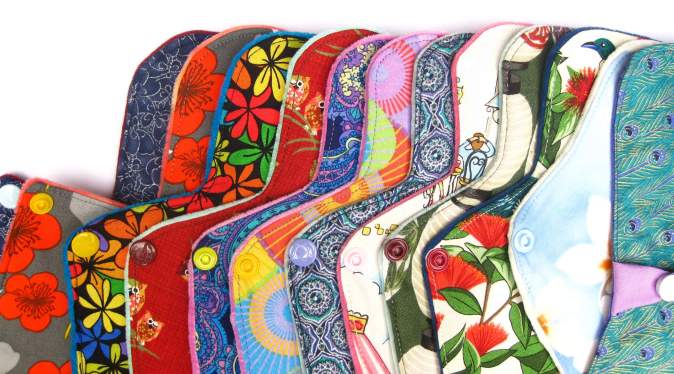
First, they are more comfortable than paper and plastic versions, second they reduce the amount of waste that you throw away, third they come in a variety of fun fabrics, fourth they save you money.
But how do I
wash
cloth pads?
After use, rinse pads in cold water until the water runs clean and then leave to soak in cold water (changing the water each day) and then throw in with the regular wash. Washing pads in a lingerie bag will reduce lint gathering on cotton velour. You can use any cycle from cold to hot, but hot water will set any stains that haven't already rinsed out. It is inadvisable to use fabric softener with these products so that absorbency is not compromised. Hang to dry, or use a regular dryer cycle. Hanging in the sun is beneficial to help remove stains and for its antibacterial action. Wringing by hand may damage the stitching and waterproof laminate. Vinegar may also damage the laminate.
How many do I
need?
You are likely to need about the same number of cloth pads a day as you would use disposible ones. Consider how many days between washing, plus allow for drying time and you can calculate the number of pads that you would need. I wash every couple of days and would need a minimum of four heavy pads, six medium and four light.
But they seem
so expensive!
A complete stash of cloth pads may cost you between $120 and $150. That is a lot in one go, however consider that over the course of a year you are likely to spend that much (or more) on disposible products. Cloth pads are durable and may last five years or more. I have some that are ten years old and still going strong.
If you are making your first foray into the world of cloth pads, then I would recommend buying a couple of light pads or liners first to try them out. Use them for spotting, just in case before your period starts, as pantiliners in midcycle and for the light days at the end of your period.
When you discover how much more pleasant they are, then expand your stash with one heavy, two medium and another light pad and then build up to a complete stash over time. I stock some pad packs which are very convenient to increase the variety and range of your pads.
If buying a pad or liner for the cost of a couple of lattes and cake at the local coffee shop still seems a lot, then you might like to sew your own pads. You can repurpose items around your house to make serviceable cloth pads and the sewing is easy. Some people sew them by hand. Check out my DIY page for links to other sites for patterns and tutorials to make cloth pads.
For a very comprehensive discussion of the costs of hand made cloth pads, have a look here.
What about
using cloth pads when out and about?
Slip your clean pads into a small bag - for example a zip cosmetics bag, a pencil case, or one of my custom made little wet bags and then stow them in your hand bag or back pack. When you change pads, wrap the soiled one up in itself. Fold the front and back in to the centre of the pad, bring the wings over the top and snap them over the top. You will have a compact little package that you can then store till you get home.
Are there other
reuseable alternatives?
Menstrual cups: If cloth pads just don't do it for you, then you should check out menstrual cups. They are worn internally and catch the flow which you can then empty out.
Cloth tampons: These cannot be sold in Australia as they are not approved by the Therapeutic Goods Act for internal use. However if you would like to try them out, you can find them on Etsy or have a look at these "ribbon wipes". Email me for more details about them.
You may also like to find out about menstrual sponges. You can buy ones that are specifically intended for this purpose, or use a natural sea sponge for cosmetic purposes, such as are sold at supermarkets and pharmacies. Choose a denser celled sponge.
What's this
about "free bleeding"?
Some women choose to bleed freely during their period. They report that they can control their menstrual flow and release it as they choose. To read more about this, please refer to this article about "nappy free women" which has a lot of information about the topic.
How to choose
the right Noonee
Wilga Cloth Pads for you.

Noonee Wilga Cloth Pads are custom made according to your requirements, although I sometimes have items available in stock.
You can choose the upper and lower fabrics, amount of absorbency, length of the pad and whether to include waterproofing.
If you wish to skip the details - click for a summary of my recommendations!
To just get started try this quick start page!
Fabrics
You can choose the fabrics for the upper, lower and inner layers according to your own requirements.
Upper surface (worn against your body)
This layer generally has a slight pile (furry) and must be something comfortable and allow moisture to easily penetrate into the core of the pad. The main decision is natural or synthetic.
- Synthetic - microfleece, minkee, suedecloth and pseudochamois.
- Natural - cotton flannelette, organic cotton, cotton velour, bamboo velour, pinwale and regular corduroy.
Lower surface (worn away from your body)
This layer can be almost anything but these are the most popular alternatives:
- cotton print - grippy, breathable, trim, great variety of fun designs
- polar fleece (plain or patterned)- moisture resistant, grippy, breathable, not quite so trim
- PUL - waterproof, can be a little slippy, not so breathable, very trim
I have a wide variety of fabrics available for making up a special pad (or collection of pads) just for you or for a special gift. I love to find fun and different fabrics for top and bottom of the pads, and if I don't have a print exactly to your liking, I can happily pop into our nearby cotton print treasure trove where there are fabrics of almost any print you can imagine.
Absorbency
The inner absorbent layers of the pad can be made from 100% cotton fabrics such as cotton fleece or flannelette or a blend of hemp/organic cotton french terry or even bamboo fleece. More layers = more absorbency.
Unless you have a particular requirement for something different, I would use an inner core of 55% hemp/45% organic cotton french terry fabric for absorbency. Hemp/organic cotton is an absorbent, durable fabric with reputed antibacterial properties.
I recommend the following numbers of layers for various
menstrual uses:
- one layer - liners and light flow
- two layers - light to medium flow, late post-partum use
- three layers - medium to heavy flow, early post-partum use
If you wish to use these pads for mild incontinence, please select the absorbency according to your requirements.
Waterproofing
A layer of PUL ( polyurethane laminate - commonly used in modern cloth nappies and for medical purposes for waterproofing), Taslon (moisture-resistant nylon and more breathable than PUL), wool interlock (natural washable wool) or polyester fleece (moisture-resistant and more breathable) can be included within the pad, as the lower surface or as a separate lay-under liner.
Fastening
All Noonee Wilga Cloth Pads close around your regular underwear using polyacetal resin snaps. If you prefer, I can use metal snaps or buttons unless you select a wingless style. Snug-fitting underwear is more effective when wearing cloth pads to help hold them against your body.
Length
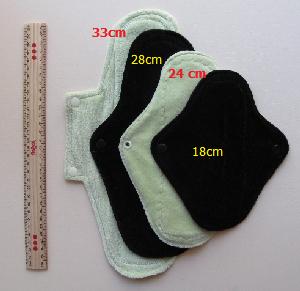
Noonee Wilga Cloth Pads are available in lengths ranging from 19cm (7") to 45cm (18") or other as requested.
Ordering
Pricing is based on length, type of external layers and number and type of internal layers.
You can order a variety of different pad styles here
I also list instock pads and custom slots in my store at the Cloth Pad Shop.
To discuss special requests (I always enjoy a new challenge!) please email me.
Summary of Marnie's recommendations
For menstrual
use
| Liner/cup backup | Light Day | Light night/Medium Day | Medium night/ Heavy Day |
Heavy night/ Super Day |
|
| Length (cm) | 19 - 25 | 19 - 25 | 25 - 28 | 28 - 33 | 33+ |
| Length (inches) | 7" - 9.5" | 7" - 9.5" | 9.5" - 11" | 11" - 13" | 13" + |
| Absorbency (layers of hemp/org cotton) |
1 - 2 | 1 - 2 | 2 | 2 - 3 | 3 + booster |
| Waterproofing | maybe | probably not | perhaps | probably | most likely |
| Width | 6cm | 6cm | 6cm | 6-7cm | 8cm |
For post partum
use
| Light | Moderate | Very heavy and Heavy flow |
|
| Length (cm) | 25 | 28 - 33 | 33 or more |
| Length (inches) | 9.5" | 11" - 13" | 13" or more |
| Absorbency (layers of hemp/org cotton) |
1 - 2 | 2 - 3 | 3 plus booster |
| Waterproofing | maybe | probably | most likely |
| Width | 6 cm | 7 cm | 8 cm |
For Urinary
Incontinence Use
| Mild | Moderate | Heavier | |
| Length (cm) | 19 - 25 | 25 - 28 | 28 - 33 |
| Length (inches) | 7" - 9.5" | 9.5" - 11" | 11" - 13" |
| Absorbency (layers of hemp/org cotton) |
1 - 2 | 2 | 3 plus booster |
| Waterproofing | probably | probably | most likely |
| Width | 6cm | 6cm | 7cm |
If you would like to discuss your particular situation in detail, please email me.

All prices in AUD. Shipped worldwide from Australia. Copyright 2003-2026 - Marnie Holmes -